Category Archives: Uncategorized

The paper of record.

Given that the Times has now printed this announcement, I suppose I have to accept that my book has actually been awarded the Bancroft Prize, that, in other words, this isn’t all some elaborate hoax. I mean, when has the Times ever been wrong about any matter of great import? (I’m not even going to bother linking to Judith Miller, because that would be overkill.)

Honestly, I’m not sure what to say about any of this. I’m very pleased, of course, and very confused and more than a little embarrassed. I’m gratified to be sharing the award with Ira Katznelson, who’s a giant in the field and who has long been one of my intellectual heroes.

Most of all, though, I’m grateful to the many people who helped me along the way: friends and colleagues who read draft after draft of the manuscript, warning me away from errors and steering me toward productive lines of inquiry; generous archivists and other historians, who often shared fruitful sources with me; funders and employers, who provided the resources necessary to complete a project as sweeping as A Misplaced Massacre; the many folks who agreed to sit for interviews, including National Park Service personnel, local landowners, and Sand Creek descendants, all of whom took real risks in speaking with me on the record; everyone at Harvard University Press, and especially my stalwart editor, Kathleen McDermott, who allowed me to take the time I needed to write the book I wanted to write; and most of all, the members of my family, who brought me enough joy that I was able to spend years thinking and writing about an event as sad and terrible as Sand Creek.

Writing a book is almost always a team effort, and never more so than in this case.

More crowdsourced history.

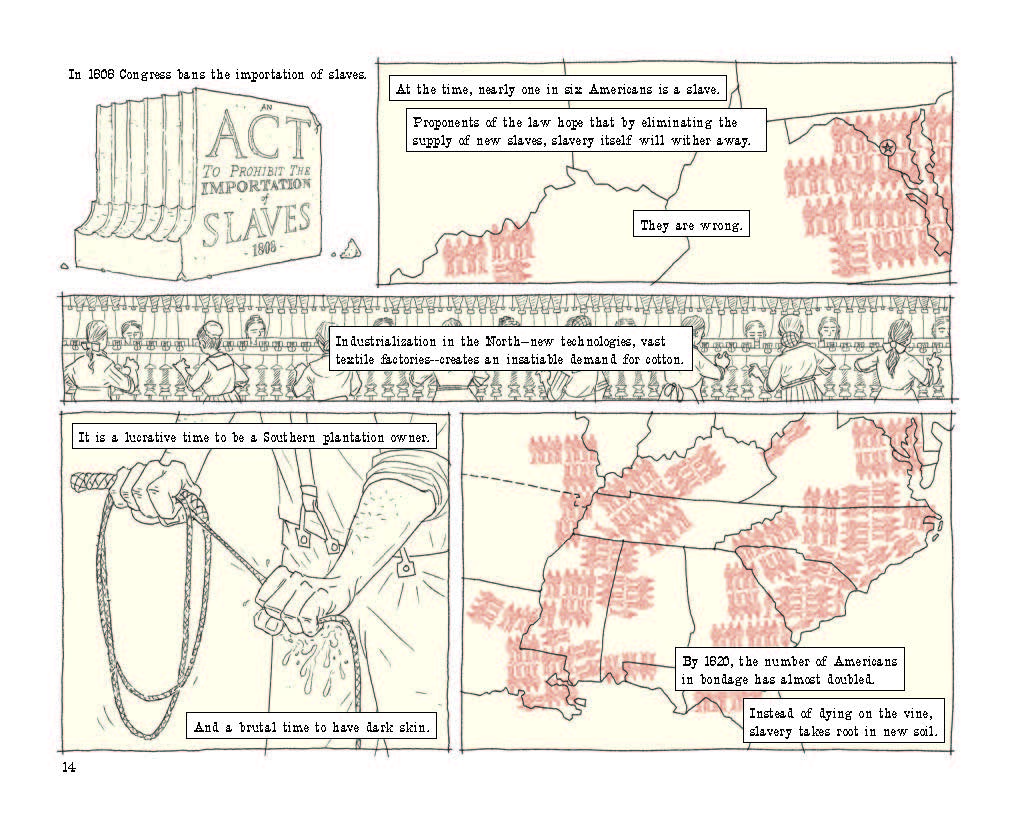
Jonathan and I are struggling with how to depict the spread of slavery in the early nineteenth century. If you check out the page below (it’s clickable), you’ll see what we’ve got so far.

slavery page

The problem, as we see it, is that the image we’ve used, which is intended to evoke the classic drawing of the slave ship Brookes, might look to some readers like a board game. And if that’s the case, then the expansion of slavey will look like the slaves are winning.

If you have any ideas for how we can fix this, please let me know.

Sweeping panoramas! A cast of thousands! In technicolor!

When Jonathan and I first started work on Battle Lines, our editor told us the book would be printed in black and white and in portrait orientation. We expected that the object itself would be pretty unimpressive, to be honest, at least as graphic books go. So you can imagine our surprise and delight when, about eighteen months ago, we handed in the first draft and the wonderful people at Farrar, Straus and Giroux said, “Oh, we think this should be printed in full color and in 8.5″ x 11″ landscape orientation.”

We were all like, “Yeah, whatever. Obviously.” I mean, we played it totally cool, because, in the words of a friend of mine, that is the manner of our rolling. But we were positively giddy. Like, Snoopy-dance happy. Until, that is, we realized that redesigning the book meant re-scripting and re-drawing almost all of it. Landscape orientation provided us with so much more room, which became both a blessing and a curse, and so we reworked all of the chapters, making the stories more expansive and the art more panoramic. We produced another draft and then another after that, trying to capitalize on the space to improve our storytelling. And the added space, despite all of the work it created, mostly was a blessing. Or whatever less loaded word you want to use instead of “blessing.”

But in all that time we pretty much ignored the issue of color. I mean, we understood intellectually that the book would be printed in color, but we kept producing stories and art in black and white. Thinking about the story in color seemed overwhelming somehow. I wish I had a better way of explaining what I mean, but there it is. Anyway, about a month ago we finished the penultimate draft of the book, which some of you have seen, and we realized that we couldn’t avoid the issue of color. And we sort of freaked out a little bit.

Again, we had produced a book in black and white. Would color make our work look like a comic book? Would it become too garish in color? Would color undermine the stories we were trying to tell? Would certain episodes become too dramatic, too over the top, or perhaps even cartoonish? We didn’t know. And so we freaked out some more.

Well, Jonathan, having returned from Antarctica (yeah, seriously), finally colored a couple of pages of the book the other day, and I’m totally reassured. He still has to figure out how blood is going to look, but the palette so far seems spot on to me. Here it is.

Sample Final Spread1

If you have any thoughts, please feel free to let me know.

Penultimate draft bleg.

A bunch of people were kind enough to read an early draft of Battle Lines and then to send along some very helpful feedback. If you were one of those people, thanks again!

That said, we’ve now got the penultimate draft done, which means that the script is far tighter and there are no more chapters with missing art. If you’d like to take a look now, please just send me an e-mail at my work address or a message at facebook.

Westword the course of empire.

Westword‘s Patricia Calhoun has been documenting the ongoing memory fights that still surround the Sand Creek massacre in Colorado. Here’s a recent piece she did on the healing run. And here’s a gallery of images from the last day of this year’s run. I’m especially taken with the various pictures of Denver’s Riverside Cemetery, one of my favorite urban landscapes, and the shots of historical markers. I’m nothing if not predictable.

Almost done.

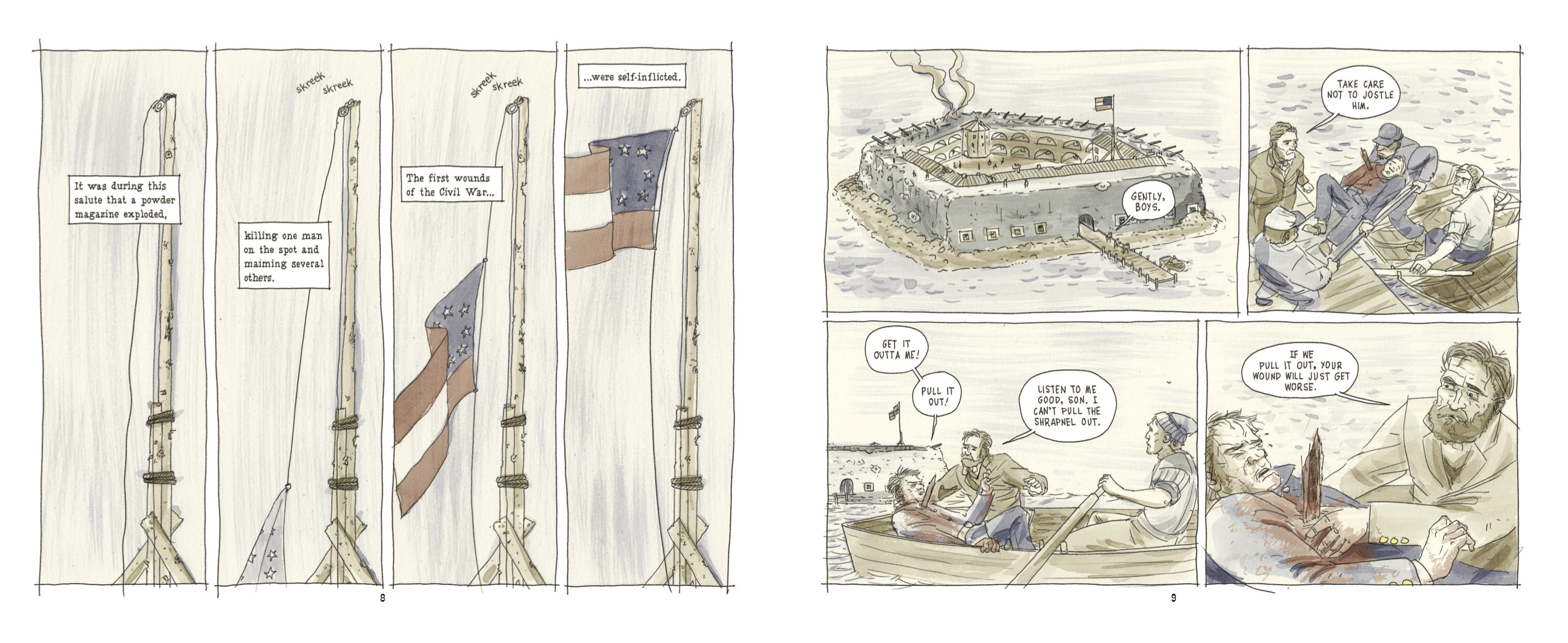
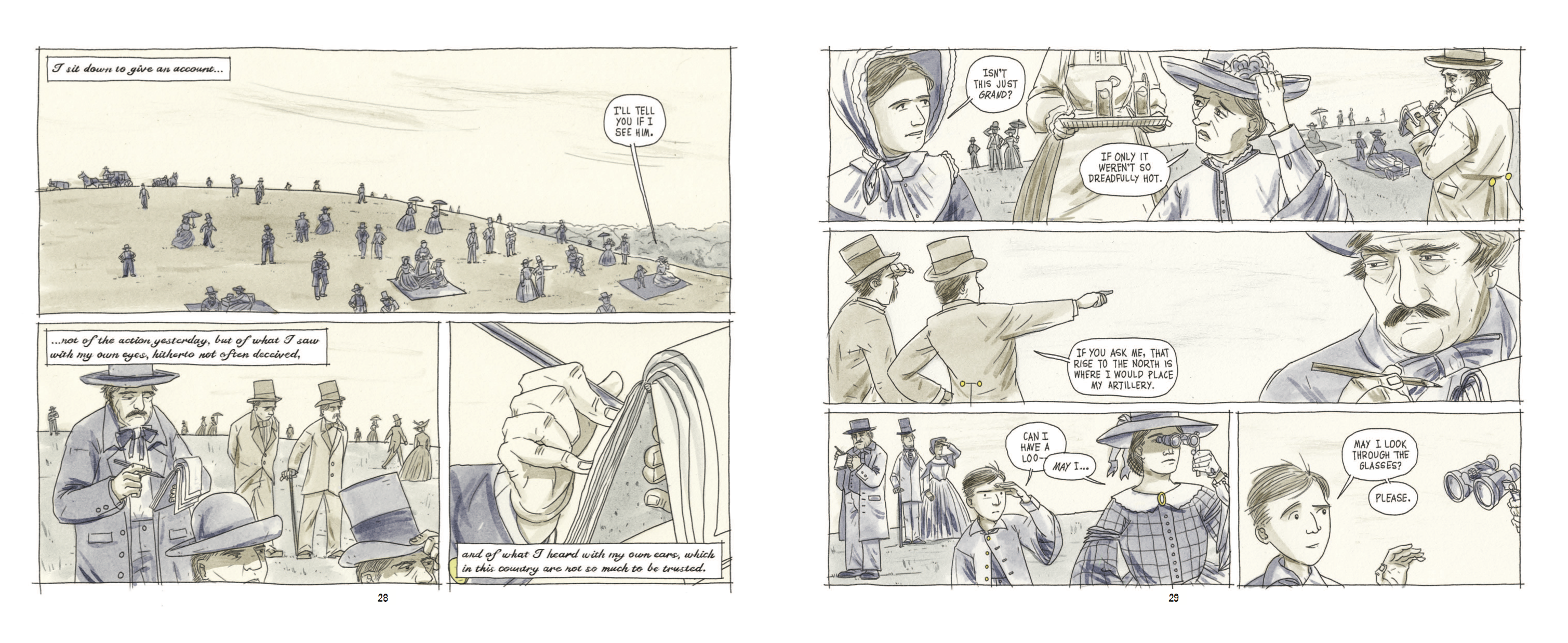
Since a few people have asked, we’re about a month out from finishing Battle Lines. The pages I’m linking below haven’t been colored and mostly haven’t been shaded either, but they’ll give you some idea of what the book will look like.

Chapter One focuses on the fall of Ft. Sumter.

Chapter Two is a montage of episodes on the road to the war.

Chapter Four explores the fate of a contraband slave.

Chapter Five looks at medical practices and the Battle of Antietam.

I’ll try to get some more of these up in the next few days.

This is great, but I’d rather have a spot in the starting lineup.

James Buss, who, when he’s not writing outstanding books, helps run the Los Angeles Lakers (NB: not really), just said nice things about my book. You can find a PDF here. Or see below for the full text of the review.

Ari Kelman. A Misplaced Massacre: Struggling over the Memory of Sand Creek. Cambridge: Harvard University Press, 2013. xiii + 363 pp. $35.00 (cloth), ISBN 978-0-674-04585-9.

Reviewed by James Buss (Salisbury University)

Published on H-AmIndian (November, 2013)

Untangling the Mystic Chords of Memory

On November 28, 1864, Colonial John Chivington responded to reported Indian threats in southeastern Colorado Territory by mustering his troops and departing for the direction of Black Kette’s Cheyenne and Arapaho villages along Sand Creek. The following day, members of the Colorado Calvary descended upon the encampments and killed more than a hundred Native people. A subsequent military tribunal exposed the tenuous ties that bound immediate history to memory. Chivington testified that the events constituted a glorious battle against a hostile foe. Captain Silas Soule, First Calvary of Colorado, Company D, declared the events a crime against humanity. Chivington won the initial dispute over memory, as the events of November 29, 1864, became known among the white settlers as the Battle of Sand Creek — Coloradans eventually erected a Colorado Civil War memorial that cast that designation into bronze. Conversely, Soule paid the ultimate price for his perceived blasphemy; on April 23, 1865, disgruntled members of the Second Colorado Calvary ambushed the young captain and murdered him in the streets of Denver.

Focusing solely on Chivington and Soule’s competing accounts, of course, neglects an important vantage point: that of the victims and survivors. Survivor George Bent tried mightily to interject his version in the nineteenth century. He worked with Oklahoma historian George Hyde to record his story and a?empt to get it published. For Bent, Sand Creek was a turning point in Cheyenne history, as it marked a change from a peaceful
cohabitation of the Plains with whites to an impoverished state of subjugation. Bent also understood connections between Sad Creek and the larger American Civil War raging mostly to his east. The Civil War, in Bent’s mind, forged a version of American racism that made Sand Creek possible: the war in the West would thereafter be viewed as Americans versus Indians (hostile or friendly).

These early tales of conflict, murder, and neglect provide fodder for the larger story that Ari Kelman tells in A Misplaced Massacre: Struggling over the Memory of Sand Creek. For Kelman, Sand Creek was and continues to be more than a semantic dispute over the designations “battle” and “massacre.” Instead, he argues the horrifying events of 1864 provide a window into the bloody link between the Civil War and the Indian wars in the American West, as well as speak loudly about the lineaments of settler colonialism that continue to shape and reshape relationships between Native and non-Native people and among Native communities today.

Kelman’s brilliant opening chapter makes these connections clear, as he maps more recent views alongside those of nineteenth-century historical actors to expose how these issues reverberate into the present. Twentieth-century naysayers argued that renaming Sand Creek a massacre belied the ultimate result of the Indian wars, namely a divined transcontinental nation. Local white boosters additionally feared that a change might implicate them in the bloody event itself. As staunch defenders of the old aphorism, “let the dead bury the dead,” these individuals sounded very much like Chivington. Politicians in the latter part of the twentieth century, however, distanced themselves from the racialized rhetoric that motivated Chivington’s remarks. They called for reconciliation. Colorado senator and member of the Northern Cheyenne Nation Ben Nighthorse Campbell empathized with Silas Soule and believed him a hero at Sand Creek. Furthermore, he blamed a renegade group of soldiers for the massacre, rather than condemn the United States or the entire army. In so doing, Campbell preached reconciliation rather than remembrance. Still, other Cheyenne
and Arapahoe leaders demanded justice and sought to use the renewed interest in Sand Creek to raise issues of sovereignty and self-determination. Like George Bent, they believed that descendants of the massacre itself should determine how the event was remembered.

Regardless of the debate happening between politicians and Native communities, those who wished to memorialize or commemorate Sand Creek faced two daunting obstacles. First, Colorado ranchers owned the land upon which the event occurred. And, second, several of those landholders claimed that the massacre took place at different locations. Driven by a congressional resolution authorizing a study of the Sand Creek site (with the hopes of creating a national park), National Park Service personnel, historians, and tribal members
debated the location of the massacre. Study leaders employed both ground-penetrating radar and oral histories from the tribes themselves. Ultimately, science seemingly disproved tribal stories, by placing the horrific scenes and villages outside of the locations marked and venerated by Cheyenne spiritual men. But in the wake of 150 years of contested and emotional memories, science took a back seat to reason. Local landowners contested these stories too, believing the old adage of realtors everywhere, “location, location, location.” If the site rested on their property, some owners believed that it would increase its value; others feared that it would bring unwelcome guests onto their lands. Regardless, any effort to mark a place for the Sand Creek Massacre seemed fraught with political, economic, and emotional challenges.

This is what is best about Kelman’s delicate treatment of the events. As a participant-observer, he knows best not to judge historical actors within his work, particularly
those with whom he worked alongside during the research for the book. Instead, he carefully untangles the knotted cords of memory that motivated his subjects and fueled their impassioned responses to perceived enemies and partners. In the process, Kelman exposes the complex chain of events that brought non-Native allies to the aid of Cheyenne and Arapahoe communities in the twentieth century, o?en for less than altruistic reasons. He reveals the competing Native voices and opinions of numerous Native communities that all claimed links to memories that were bound to the land around Sand Creek. And, he chronicles the role of government agents entrusted to balance those competing voices and interests. Ultimately, A Misplaced Massacre is at once sophisticated and graceful, involving a dizzying array of characters (and some of them are truly characters) that span nearly a century and a half–Cheyenne and Arapahoe descendants, soldiers, settlers, academic historians, politicians, members of the National Parks Service, oral historians, landowners, scientists, geographers, armchair historians, and more. By teasing apart the issues that connect and divide these different groups of people, Kelman reveals the collision of the past and the present. He also provides insights into the very process of historical investigation.

Kelman ultimately concludes, “This story of memorializing Sand Creek suggests that history and memory are malleable, that even the land, despite its implied promise of permanence, can change, and that the people of the United States are so various that they should not be expected to share a single tale of a common past” (p. 279). These lessons will become (and actually already are) important as Americans come to reconcile a violent past with a willingness to explore continental histories that diverge from progressive narratives of settler domination. Despite what Winston Churchill once proclaimed — “History is written by the victors” — we all eventually decide whether or not to accept the story presented to us of the past.

Nice notices.

Several friends have let me know that Michael Elliott — whose book, Custerology, is really outstanding — penned a very kind review of A Misplaced Massacre in the most recent JAH. One of those friends was even nice enough to send me a copy of the offending document. So if you care (I’m thinking of you, mom and dad), here a pdf of the review.

Or, if you’d prefer, here’s the review:

A Misplaced Massacre: Struggling over the Memory of Sand Creek. By Ari Kelman. (Cambridge: Harvard University Press, 2013. xvi, 363 pp.$35.00.)

Ari Kelman’s A Misplaced Massacre tells the remarkable story of the incorporation of one of the most nefarious episodes of U.S. history into the National Park Service (NPS). In November 1864 Col. John Chivington led an attack on an encampment of Cheyenne and Arapaho Indians in present-day eastern Colorado who believed that they were under the protection of a nearby federal fort. Chivington’s men killed more than 150 Cheyennes and Arapahos, and in the aftermath the soldiers publicly displayed trophies of scalps, ears, and even genitals. The violence shaped the social landscape of the plains for decades and reverberated throughout the United States. As the Civil War neared its conclusion, multiple congressional committees conducted investigations into what was frequently called Chivington’s massacre, and Chivington’s name became a byword for excessive violence even among officers of the U.S. military.

A Misplaced Massacre describes the tortuous path toward national commemoration of these events from the 1990s to the 2007 opening of the Sand Creek Massacre National Historic Site — the first NPS unit to use the word massacre in its name. As Kelman explains, NPS officials saw in the events at Sand Creek the possibility of continuing their efforts to incorporate Native American voices and to model federal-tribal cooperation. Therefore, when the site was inaugurated, the dominant rhetoric was one of optimism about the healing power of memorialization. However, the process that led to the site’s creation did much more to expose deep and painful divisions between the various stakeholders than to heal them. “Rather than improving federal-tribal relations, creating the memorial had laid bare two centuries of conflict between the U.S. government and the Cheyennes and Arapahos,” Kelman writes. “As it had during the era of the CivilWar and the Indian Wars, a struggle over control of the landscape had ignited modern disputes” (p. 19).

Kelman’s argument that the commemorative struggles of the twenty-first century are rooted in nineteenth-century histories is one of the many strengths of A Misplaced Massacre. Another is his surefooted storytelling, featuring a cast of characters that includes tribal descendants of the victims of Sand Creek, NPS officials, professional and amateur historians, a casino operator, area landowners with their own complicated set of motives, and politicians and government officials at the state, tribal, and national levels. The book tells a story of shifting alliances, political compacts, historical sleuthing, and deep emotion. It is, finally, a story of the West — and Kelman’s sensitivity to the complexity of regional politics makes him an astute and compelling guide. He notes, for instance, the deep and abiding mistrust of the federal government that unites the rural communities of the West, whether they are populated by white ranchers or Native Americans. Kelman also understands the traditions of military service that join those communities, as well as the climate of patriotic militarism that dominates the post–September 11, 2001, landscape of the latter part of his tale. A Misplaced Massacre makes clear that what is most surprising about the National Historic Site is not that it took so long to establish, but that it ever opened at all.

Consider the simple question that drives much of the drama in Kelman’s book: Where was the precise location of the Sand Creek massacre? The enabling legislation for the site required that the NPS determine the exact terrain where the violence occurred so that the land could be purchased. For decades, local residents and tribal groups had believed that they understood the location of the massacre, but archaeological efforts in the 1990s generated more questions than answers. As a result, both the NPS and tribal groups engaged oral histories, historic maps, and contemporary archaeology in a long and often-fractious search for the correct ground on which to commemorate the massacre.

Kelman’s account of a 1999 archaeological dig that included NPS officials and representatives of tribal descendants is one of the most revealing episodes of the book. Even as the archaeological team assembled by the NPS celebrated a dramatic find of physical objects, the team’s emotional response left the tribal representatives distressed at the “whooping and hollering” that accompanied each find. Kelman quotes a Northern Cheyenne observer to the scene, who remembered that the NPS archaeologists “were jumping up and down, doing cartwheels and back flips when they found something. But the Cheyennes, they just walked off” (p. 129). It would be years before the groups could agree on an interpretation of the evidence that proved acceptable to all.

Here and elsewhere Kelman is a deft interpreter of the cultural conflicts at the center of this process of commemoration. He understands that they result from the incommensurability of the agendas that brought the parties to the table. For many of the tribal representatives involved in the process, the creation of the National Historic Site was only a means toward restorative justice, particularly through the payment of reparations that were promised — but never paid — to the survivors of Sand Creek in the 1865 Treaty of the Little Arkansas. For the NPS, the very act of commemorating the dark history of Sand Creek is an achievement — a testament to the ability of the United States to face its own troubling history, to overcome the divisions of the past in the hope of a better future. Kelman never tries to gloss over these differences, and he is forthright about their consequences.

The sheer difficulty of creating the Sand Creek National Historic Site is what makes A Misplaced Massacre essential reading. Kelman is alive to the thick emotion of historical commemoration and its political reverberations. The easy path for him would have been to tell a story of victory over division—of bridging gaps and mending fences to work for the common good. But Kelman refuses to replicate nineteenth-century triumphalism in his account of twenty-first century memory. Sand Creek was a “misplaced massacre” because it disturbs so many stories that Americans have told themselves about their nation, and it cannot be found through a simple tale of reconciliation.

Michael A. Elliott
Emory University
Atlanta, Georgia