[youtube=http://www.youtube.com/watch?v=eJh_EUrEAZg&w=420&h=315]
Whoever on Sesame Street thought it was a good idea to have Richard Pryor teach your children the alphabet was obviously right.
[youtube=http://www.youtube.com/watch?v=eJh_EUrEAZg&w=420&h=315]
Whoever on Sesame Street thought it was a good idea to have Richard Pryor teach your children the alphabet was obviously right.
Steve Kantrowitz raises an important point in the comments on this post: majors aren’t the whole story. It would be helpful to have access to a longitudinal study of enrollments in the humanities. Although it seems to me that enrollments may be shaped as much by changing university requirements as by student interest, I’m still curious to see that data. Does anyone happen to know where I might find those numbers?
If you’re a fan of what looks like it may well be innumeracy*, the latest installment from The Times in “crisis in the humanities” concern trolling is pretty darned good.
In all fairness, I’ll grant a couple of the author’s premises: many people, including leading humanists, really do feel** like there’s a crisis in the humanities. And there does seem to be a crisis in the humanities at Stanford. Heck, I’ll go one further: in time, that crisis well might become a self-fulfilling prophecy for universities around the United States.
But the numbers, linked here***, suggest that for the moment the crisis largely remains one of confidence. So maybe The Times should write an article about how humanists are neurotic and see doom and gloom wherever they look. The author can interview me!
Really, though, I’d read an article about who’ll benefit from an actual crisis in the humanities and whether those interests are implicated in drumming up this fake crisis.
* Without footnotes or links at The Times, I can’t know if the author is actually innumerate, just confused, or has access to numbers I’ve never seen (and suspect don’t exist).
** Because they read The Times? Because they listen to the Secretary of Education natter on and on and on about STEM? Because their funding is being cut? Who knows?
*** Nobody clicks links these days (because of the crisis in humanities blogging), so here’s the relevant information: Table 289 in The National Center for Education Statistics’s “Digest of Education Statistics” shows degrees granted by field of study for selected years between 1970 and 2010. That table reveals that in 1970-1971, 17.1% of students who received BAs in the United States majored in a humanities discipline. Three decades later, in the midst of the crisis in the humanities we hear so much about, that number had plummeted to 17%.
It’s worth adding that the number of students receiving MAs and PhDs in humanities disciplines has contracted (from 14.6% to 7.9% for MAs and from 6.8% to 4.9% for PhDs).
As many of you know, a co-author and I have been working on a graphic history of the Civil War. It’s nearly done now (forthcoming from FSG), and I’m wondering if any of you want to take a look at what we’ve got so far. I’m thinking of this as an internal peer review — that way I can blame my inevitable errors on you. Kidding aside, if you’d like to help out, please let me know.
I’ve seen a lot of talk lately about the ongoing “crisis in the humanities.” It may be that there is such a thing, for after all, there are lots of different ways to define a crisis. But it’s worth noting that if one uses the working definition that seems to be most common — declining undergraduate enrollments — the humanities turn out not to be in crisis at all.
If you click here (the National Center for Education Statistics’s “Digest of Education Statistics”), you’ll see Table 289, which shows degrees granted by field of study for selected years between 1970 and 2010. Cutting to the chase, that table reveals that in 1970-1971, 17.1% of students who received BAs studied in a humanities discipline. Three decades later, in the midst of the crisis in the humanities, that number had plummeted to 17%.
It’s worth adding that, based on these statistics at least, there is a crisis in education (from 21% to 6%) and perhaps the natural sciences (from 9.8% to 7.6%), and also that the number of students receiving MAs and PhDs in humanities disciplines has contracted (from 14.6% to 7.9% for MAs and from 6.8% to 4.9% for PhDs). All of which is to say that there may be a crisis in the humanities, but it appears to be largely a crisis of confidence.
I don’t post about politics much these days, because: a) been there, done that; and b) I quickly become morose when I think about the subject. That said, Frank Rich’s latest column is worth a look, as it does a nice job documenting the ways in which the top tier of the Democratic Party, at least in Washington, has completely lost its way.
“Better than the alternative” remains good enough to capture my vote in election after election, but it’s hardly the stuff of folk songs — or even of effective politics.
This is a beautifully done essay, the kind of writing that makes one want to be a writer.
My review of Walter Johnson’s River of Dark Dreams is out in this week’s TLS. Because the paywall over there is pretty weird, and because a few people have asked me for a look at this, I’m going to paste the entire text below the fold. Or, if you’d prefer a pdf, try this.
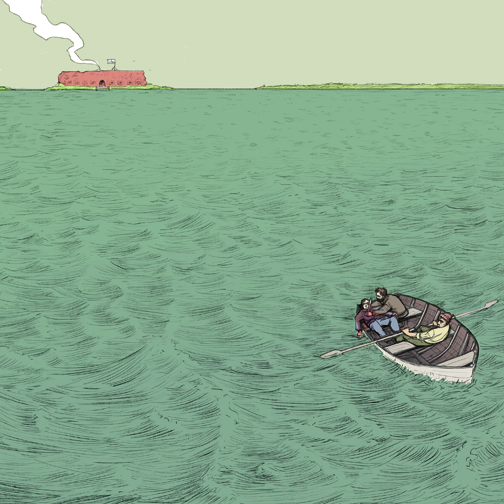
In the background, you can see a smoldering Fort Sumter. In the foreground, you can see a boat bearing a wounded soldier, a physician, and a man rowing them toward shore. This is what the last page of the first chapter of Battle Lines will look like. Sort of. More or less. Or something. What do I look like? Some kind of artist?
If you’re interested — and I can’t imagine why you wouldn’t be! — you can listen here to a long interview I sat for at KGNU, Boulder’s community radio station, last spring. I show up just before the 32-minute mark.