Some of the comments on the post below — not the one about Sandra Dee’s Kwanzaa cake, which, thanks for asking, was a huge hit at my Superbowl party! — got me thinking about one of the challenges Eric and I faced when we taught our WWII class last fall, a challenge that also haunted me while I wrote my book: how to keep an audience from becoming inured to an endless litany of stories about atrocities and war crimes. Because really, by the time I was writing lectures about 1942-44, or detailing, for the umpteenth time, what happened to the human remains taken from the Sand Creek killing field, the parade of horribles became pretty overwhelming. And the last thing I wanted was to leave students or readers thinking, “Oh, please, not another concentration camp/firebombing/brutal purge/case of cavalrymen hacking off their victims’ genitalia. I’m so over this. It’s time to check facebook!”[1]
In our class, we tried two different tactics. First, we made sure that in several of our lectures we didn’t talk very much about body counts or the horrors of war. Instead, we spent our time discussing what was happening on the home front, in one case by considering an era in which Daffy Duck exhorted Americans to do their patriotic duty by paying their federal taxes:
And second, we slowed our pace and scaled down. That sounds counterintuitive — and, honestly, I’m not sure it worked. But the idea was that by week seven, the students were overwhelmed by numbers and images: millons dead, cities incinerated, bodies mutilated. So we dropped our pace and lingered in Anne Frank’s apartment in Amsterdam, revisiting that iconic story, or examined the campaign rhetoric leading up to the 1944 election in the U.S.:
Yeah, we showed a bunch cartoons. And then we pivoted back to the horrors of war.
In the book, I employed a different tactic: I maintained my focus on atrocities and depredations, because I think that’s how memories of Sand Creek have most often been shaped through the years. But, as the pages and horror stories began piling up, I started to approach those subjects obliquely. For example, there’s a long section of literary history, in which I examine Helen Hunt Jackson’s Century of Dishonor and Dee Brown’s Bury My Heart at Wounded Knee. Then, in another instance, I explain how a successful effort to repatriate the remains, held by the Smithsonian Institution[2], of some of Sand Creek’s victims played an important role in the National Museum of the American Indian’s creation story.
As in the case of the World War II class, what I was trying to do with these sections of the book was pull off something like a literary sleight of hand: having readers look elsewhere while I continued writing about the importance of the bodies desecrated at Sand Creek. If appropriate cartoons had been available to me, I probably would have used those as well.
Which leads me to the image below. Matthew Booker linked to this yesterday:
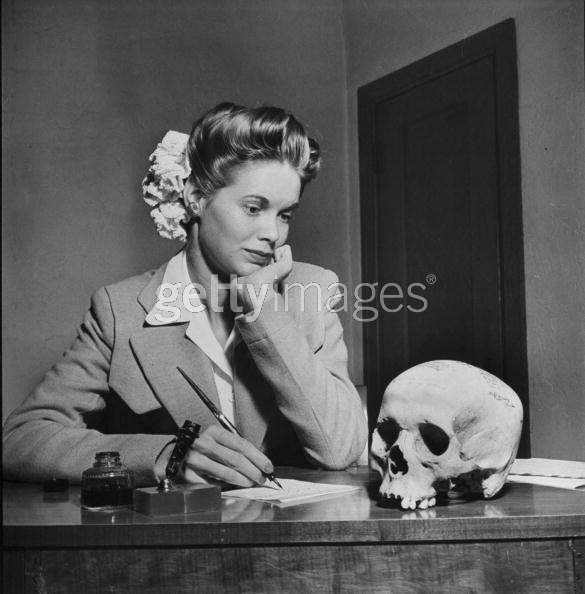
The image, which appears to have been printed in either Time or Life in 1944, is captioned:
Phoenix war worker Natalie Nickerson penning her Navy boyfriend a thank you note for sending her a Japanese soldier’s skull he gathered as a souvenir while fighting in New Guinea.
As with the anecdote about Congressman Walter presenting FDR with a letter opener fashioned from a Japanese soldier’s forearm, I think this image shocks me from my usual torpor by taking a well-known fact — that bodies were profaned by American and Japanese soldiers fighting in the Pacific theater — and placing it in an unexpectedly genteel context. In the first instance, a congressman gifts President Roosevelt with a carved ulna[3]; in the second, an attractive woman pens a thank-you note to her boyfriend for the lovely skull he sent her as a present: “Thanks, sweetie! When I fill the cranium with geraniums, it really brightens the apartment right up!” In the end, it’s the juxtaposition of the unthinkable with the everyday that brings me up short, forcing me to reconsider, with fresh eyes, something horrible that I already knew well but, numb to its implications, typically glossed over.
[1] Yes, I’m cool enough to know that my students are too cool for facebook. But I’m nowhere near cool enough to know that they’re doing instead. I’d like to think it’s something totally retro, like sock hops.
[2] Until recently, the Smithsonian had among its Sand Creek holdings the skulls, both of which revealed a great deal of trauma, of an adolescent girl and a pre-pubescent boy. Whether the boy and girl were Cheyenne or Arapaho, the Smithsonian wasn’t certain. I’m not sure whether that matters.
[3] Or radius, I suppose. Whatever, I wanted to write “ulna.”
I always thought that Christopher Browning effectively conveyed the atrocities committed by the Wermacht in his book *Ordinary Men.* His writing is spare, almost clinical, and it’s the slow accumulation of numbers that gets you in the end. I highly recommend the book, if you need some spare atrocity reading. Why am I commenting so much on your posts? Perhaps you need to come back to Oklahoma to team-teach that course with me on American-Spanish civil wars and the terrors that follow.
Browning’s book is excellent. We taught primary sources only, or we might have used it. Have you read Bloodlands yet? It’s another amazing accounting of the horrors of the war, and like Ordinary Men, written in a very understated fashion.
No, it’s on my list of reads. He gave an amazing talk from his book at OU last year.
That photograph of Natalie Nickerson and the Japanese soldier’s skull ran as Life‘s picture of the week in the May 22, 1944 issue. This link should take you to the page.
Note that the caption is different from the one in the photo archive: the inscription on the skull must have been a conscious attempt to draw a parallel (in the minds of the American soldiers who sent it, at least) between the Pacific War and the Indian wars. Life also added: “The armed forces disapprove strongly of this sort of thing” – so at least this wasn’t considered casual enough to be unremarkable.
Thanks, Andrew. That’s really interesting. And I’m sorry to have taken so long in responding to your comment. I’ve been on the road and neglecting the blog.