I’m heading out on a book tour next week. Or maybe it’s a “book tour.” I can’t tell for sure yet. I’ll let you know from the road. Regardless, here’s my schedule.
Jim Oakes, who just won the Lincoln Prize for his Freedom National, above offers his answer to the enduring historiographical question, “Who freed the slaves?”
Given the brevity of his remarks, Oakes provides a relatively sophisticated interpretation of the relationship between high politics (the Republican Party’s policy-making apparatus) and human behavior (the actions of the slaves themselves). In the end, Oakes gives a perfect historian’s answer, suggesting that Republican lawmakers, when they crafted policy, counted on the slaves to free themselves, meaning that there was real synergy between public policy and the individual and group agency of African Americans seeking freedom.
It seems that a landowner wants to sell theOglala Sioux an important part of the WoundedKneemassacre site. Some 150 Native people, all killed by the 7th Cavalry on December 29, 1890, are buried on James Czywczynski’s land, and Czywczynski wants the Oglalas to have that land back. The catch, of course, is money. Land in that part of South Dakota isn’t especially pricey, and in this case it sounds like the 40 acres in question has a fair market value of less than $10,000. Czywczynski, though, wants $3.9 million. History costs.
Czywczynski believes his land is worth so much not only because it provided the setting for one of the bloodiest chapters in the West’s history, but also because of echoes of that violence in the relatively recent past. Czywczynski bought the land in 1968. He planned to start a business there — a museum and trading post — with an eye toward capitalizing on thousands of heritage tourists who visited Wounded Knee every year. But then, during theoccupationofWoundedKnee in 1973, tribal activists burned Czywczynski’s buildings, robbing him of what he describes as “a wonderful opportunity to get into private enterprise.”
Apparently still angry about the incident, and unsatisfied with the insurance settlement he received more than thirty years ago, Czywczynski is seeking what he sees as fair recompense from the Oglalas. And if he doesn’t get his money by May 1, his land goes on the open market. Ever the entrepreneur, Czywczynski “is building a website to market [his property] to national and international bidders.” Czywczynski “adds that he has the utmost respect for the Wounded Knee burial site and the Lakota people. He would prefer the tribe develop his parcel into a tourist attraction rather than leave it at the mercy of an unknown entity”:
Say you buy it, you could do anything with it. You could set up apartments or a condominium or a casino; you could do anything of that nature. But it should be done correctly — the hallowed ground where these people died.
Unlike the case of Wounded Knee, though, Bill Dawson became friendly with the tribal descendants. After initially threatening to put his land up for sale to the highest bidder, Dawson worked closely with Senator Campbell and the Sand Creek descendants for years, using his property rights and their cultural authority to leverage the price he wanted — $1.5 million for land valued on the open market at approximately 1/10th that number — from a casino corporation that then handed the site over to the Cheyenne and Arapaho Tribes of Oklahoma. The C and A, in turn, offered the casino corporation considerations in ongoing negotiations to manage the tribes’ gaming parlors. It was, all things considered, a good deal for all of the parties concerned. It did, however, complicate future land deals, including, perhaps, the one mentioned above at Wounded Knee. It’s difficult to know if James Czywczynski followed the story of the Sand Creek site, but the similarities are striking.
Having spent the past few days working on a talk and some other stuff, I have nothing smart to say today. So instead of something smart, I offer you this incredibly charming video of a small child rocking out to Bad Brains.
If you or someone you know is interested in participating this coming summer in an NEH Landmarks of American History and Culture seminar on the transcontinental railroad, please see here for more information. It should be a very good time.
I probably should have mentioned this awhile ago, but the book got reviewed over at unfogged. Along with the nice review in Kirkus and Bill Emblom’s thoughtful assessment over at Amazon, that makes three! I’ll probably keep posting as (if?) more reviews come in.
This is an excerpt from an offer I just received via e-mail,
Dear Professor Ari Y. Kelman[1]:
Students want lower cost textbooks and textbooks that are accessible on their smart phones, iPads, and laptops. We faculty at [unethical textbook publishing company][2] have developed a new and exciting Early American History text that will meet your needs and the needs of your students. I want you to review a preview of this text and I want to offer you an honorarium for test marketing this text in your classes. On the average you would receive $500 per class, based on student numbers, and would do a faculty evaluation form and some student surveys, not a lot of work.
Not only will this text benefit your students with the videos and links and accessible e-book and free printed text, but the honorarium will be beneficial to you as the budget cuts and lack of summer school continues[3]. Send me an email with your mailing address and I will send you the complete package. Hope this helps you and your students.
Hear me now, textbook publishers: I’ll sell out, sure, but not that cheap.
Some of the comments on the post below — not the one about Sandra Dee’s Kwanzaa cake, which, thanks for asking, was a huge hit at my Superbowl party! — got me thinking about one of the challenges Eric and I faced when we taught our WWII class last fall, a challenge that also haunted me while I wrote my book: how to keep an audience from becoming inured to an endless litany of stories about atrocities and war crimes. Because really, by the time I was writing lectures about 1942-44, or detailing, for the umpteenth time, what happened to the human remains taken from the Sand Creek killing field, the parade of horribles became pretty overwhelming. And the last thing I wanted was to leave students or readers thinking, “Oh, please, not another concentration camp/firebombing/brutal purge/case of cavalrymen hacking off their victims’ genitalia. I’m so over this. It’s time to check facebook!”[1]
In our class, we tried two different tactics. First, we made sure that in several of our lectures we didn’t talk very much about body counts or the horrors of war. Instead, we spent our time discussing what was happening on the home front, in one case by considering an era in which Daffy Duck exhorted Americans to do their patriotic duty by paying their federal taxes:
And second, we slowed our pace and scaled down. That sounds counterintuitive — and, honestly, I’m not sure it worked. But the idea was that by week seven, the students were overwhelmed by numbers and images: millons dead, cities incinerated, bodies mutilated. So we dropped our pace and lingered in Anne Frank’s apartment in Amsterdam, revisiting that iconic story, or examined the campaign rhetoric leading up to the 1944 election in the U.S.:
Yeah, we showed a bunch cartoons. And then we pivoted back to the horrors of war.
In the book, I employed a different tactic: I maintained my focus on atrocities and depredations, because I think that’s how memories of Sand Creek have most often been shaped through the years. But, as the pages and horror stories began piling up, I started to approach those subjects obliquely. For example, there’s a long section of literary history, in which I examine Helen Hunt Jackson’s Century of Dishonor and Dee Brown’s Bury My Heart at Wounded Knee. Then, in another instance, I explain how a successful effort to repatriate the remains, held by the Smithsonian Institution[2], of some of Sand Creek’s victims played an important role in the National Museum of the American Indian’s creation story.
As in the case of the World War II class, what I was trying to do with these sections of the book was pull off something like a literary sleight of hand: having readers look elsewhere while I continued writing about the importance of the bodies desecrated at Sand Creek. If appropriate cartoons had been available to me, I probably would have used those as well.
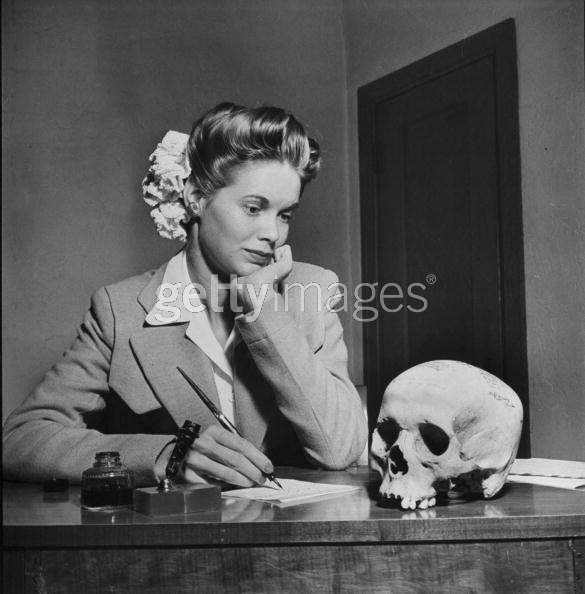
The image, which appears to have been printed in either Time or Life in 1944, is captioned:
Phoenix war worker Natalie Nickerson penning her Navy boyfriend a thank you note for sending her a Japanese soldier’s skull he gathered as a souvenir while fighting in New Guinea.
As with the anecdote about Congressman Walter presenting FDR with a letter opener fashioned from a Japanese soldier’s forearm, I think this image shocks me from my usual torpor by taking a well-known fact — that bodies were profaned by American and Japanese soldiers fighting in the Pacific theater — and placing it in an unexpectedly genteel context. In the first instance, a congressman gifts President Roosevelt with a carved ulna[3]; in the second, an attractive woman pens a thank-you note to her boyfriend for the lovely skull he sent her as a present: “Thanks, sweetie! When I fill the cranium with geraniums, it really brightens the apartment right up!” In the end, it’s the juxtaposition of the unthinkable with the everyday that brings me up short, forcing me to reconsider, with fresh eyes, something horrible that I already knew well but, numb to its implications, typically glossed over.
This is the cake I’ll be curating for my guests today. I will, of course, alter it slightly, frosting it with an image of Ray Lewis cradling a sheep in his arms. And then, as the good Lord smites down the wicked Niners, I’ll take comfort in the thought that Sandra Lee might be the next flotus.*
* From Michelle Obama to Sandra Lee? A synecdoche for an empire in decline.