This post cuts considerably deeper than most other analyses of L’Affaire Baptist[e] that I’ve seen. It’s worth a read.
Born of blood.
Leave a reply

This post cuts considerably deeper than most other analyses of L’Affaire Baptist[e] that I’ve seen. It’s worth a read.
That’s the penultimate sentence of this, literally the dumbest review I’ve ever read (and yes, I’m including all of the crap I’ve written through the years). Having said that, the comments are actually awesome. Yes, I just wrote that: the comments are awesome; you should read them.
This letter, about the Salaita case, is very good stuff from the AHA. Over on facebook (spit when you say it), Steve Kantrowitz highlighted this passage in particular:
“The First Amendment protects speech, both civil and uncivil. It does so for good reason. The United States made a wager that democracy can flourish only with a robustly open public sphere where conflicting opinions can vigorously engage one another. Such a public sphere rests on the recognition that speech on matters of public concern is often emotional and that it employs a variety of idioms and styles. Hence American law protects not only polite discourse but also vulgarity, not only sweet rationality but also impassioned denunciation.”
And of course the boundaries of academic freedom should be more rather than less capacious than those laid out by the First Amendment.
This back-and-forth between Cary Nelson and Feisal Mohamed about the Salaita case is pretty weird, mostly because Nelson initially seems to be trying to backpedal but then doesn’t make much progress. But I thought this part, from Mohamed, was quite well put:
“‘Civility’ has always been a convenient pretext for excluding certain people and ideas from the academy, which I imagine is why the national AAUP voiced reservations about it. There is some irony, first of all, that such terms as ‘civility’ and ‘collegiality’ were often used in the postwar years to justify the exclusion of Jewish faculty. That is just one instance when a threat to civility has really meant ‘too ethnic for our comfort’—though it could also mean ‘too leftist’ or ‘too feminist.’ It is especially troubling, then, that the university has used the term to trump the internal decision-making of an ethnic-studies program—and a program of American Indian studies, no less, as though the natives were not capable of civil conduct if left to their own devices.”
There is indeed “some irony” there.
A friend who refuses to join facebook (smart friend) asked if I’d post this here, so she can see it. Okay, here it is.
I’m not sure how this challenge thing works, [name redacted to protect the innocent], so I’m just going to do my best. Here are ten books (actually eleven (well, maybe it’s eighteen — plus two CDs)), arrayed in roughly the order I read them/listened to them, that shaped how I think and perhaps even who I am:
1) A Wrinkle in Time — I didn’t know there were bookstores when I was in second grade (my parents believed exclusively in libraries, you see), so I spent several days trying to hunt and peck the whole text out on the old Underwood typewriter that sat on a battered desk in the family room.
2) From the Mixed-Up Files of Mrs. Basil E. Frankweiler — I’ve loved compound adjectives and The Metropolitan Museum of Art ever since.
3) Mrs. Frisby and the Rats of NIMH — So harrowing for a third grader. So filled with anxiety and loyalty and wonder and weird allusions to scientific research. I loved it so much then. I still do, though I now realize that it’s very unfair to corvids. I should also mention Robert C. O’Brien’s Z for Zachariah, a terrifying account of survivors wandering the land after a nuclear holocaust. Bonus fact: O’Brien died while writing that book. His death was noted as an aside in the text, which freaked the fuck out of little me.
4) Fear and Loathing in Las Vegas — I hate admitting it, but this one was important for a kid who wanted so badly to be cool in middle school — and just wasn’t at all. I used to be able to recite big chunks of this book. My brain is put to better uses now: like keeping up with facebook.
4a) Under the Big Black Sun — I’m breaking the rules here, I know, but John Doe’s and Exene Cervanka’s lyrics were like a novel (ed. note: that’s a very pretentious thing to say!), and had, like, a totally yooge impact on how I understood the books I was reading at the time. Or so I told myself.
5) To Kill a Mockingbird — Yeah, sure, it would be way hipper to say this or that book by William Faulkner or, better still, Walker Percy — As I Lay Dying? The Moviegoer? — but I’m a very trite person (see above).
6) Go Tell it on the Mountain or Another Country — We’ve arrived at the dreaded college years, when I read a lot of books, most of which I’ve totally forgotten, and so try as I might, I can’t pick just one thing by James Baldwin. Oh man, Giovanni’s Room just gutted me, so maybe that one?
6a) It Takes a Nation of Millions to Hold Us Back — What I said in 4a is just as true here. I can’t really think about what I was reading at that time without remembering this CD BLOWING MY MIND. Also: I remained terribly uncool in college, but I was still working at it. E for effort, Ari!
7) Slouching Towards Bethlehem or The White Album — And now we’ve entered the maelstrom (a really great maelstrom!) of graduate school, and I can’t possibly choose just one of Joan Didion’s collections of essays. Yes, Didion’s politics are weird (at best), and she’s sometimes hugely off-putting as a person and writer, but she sure can set a scene.
8) Virgin Land, Machine in the Garden, Black Image in the White Mind, White Over Black, and Civilizing the Machine — What can I say? I’m a
huge sucker for great works of intellectual history and American Studies.
9) Nature’s Metropolis — Were it my book, I probably would have lopped off the last chapter (sorry, Bill!), but I still think it’s a work of real genius (which means that it couldn’t possibly be my book, so I should just shut up).
10) The Pine Barrens — John McPhee, like Didion, is who I want to be when I grow up and become a writer. The Pine Barrens is McPhee’s best book.
11) Independence Day — Because this list goes to eleven, I’m going to add my favorite of Richard Ford’s books and essays. I’m pretty sure this one doesn’t contain a single sentence that isn’t almost perfect.
I’m so sorry, Lorrie Moore! I totally heart you and should have found room for you on the list during the college/graduate school years!
Also, I’m not going to tag anyone else, because I loathe chain letters.
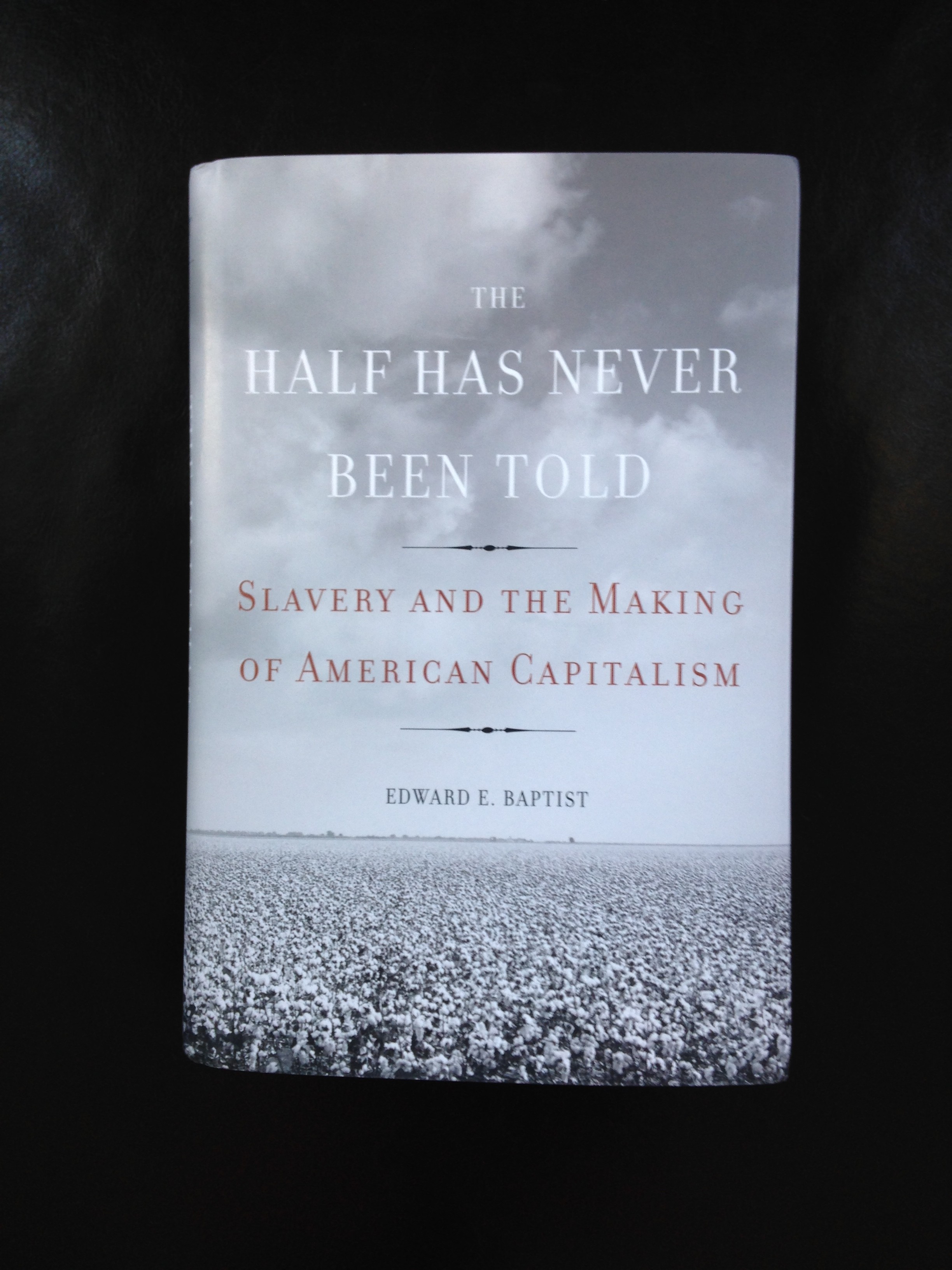
Look what just arrived in the mail! An advance copy of Ed Baptist’s new book, that’s what! If you haven’t already done so, you should order three or four for the holiday season. Because nothing says stocking stuffer quite like a book that places slavery exactly where it belongs: at the very center of the history of American capitalism.
This visualization of coastal loss in Louisiana is both beautifully done and totally depressing. So, if you’re anything like me — a depressive person who enjoys beautiful things — you might want to take a look. Or maybe you’re happy and like ugly things, in which case, whatever.
If you’re interested in the relationship between narrative and how we experience the passage of time, I recommend this fascinating essay* about Richard Linklater’s Boyhood.
I don’t think you have to have seen the film to appreciate the essay, but, because of the relationship between narrative and how I experience the passage of time, I could be wrong.
* Truth in advertising: the author is an old friend.
Sue Schulten, who’s a truly great historian and an even better person, has written another outstanding essay about history, politics, and cartography.
If you haven’t read Sue’s latest book, you really should. And while you’re waiting for your copy to arrive, take a look around the companion web site.
I’ve been keeping an eye on the tempest in a teapot surrounding Rick Perlstein’s apparently brilliant new book. Perlstein, as you may know, is the author of other terrific books about modern conservatism: see here and, for his most celebrated (at least until now) work, here. In addition to that, he’s also something of a darling of progressives in the United States, in part because he wears his politics on his sleeve, but also because he reaches out to what some people call the Netroots. He is, then, an excellent historian, an activist, and a relatively early adopter and shrewd user of social media as a communications/marketing tool.
He’s also being accused of plagiarism: see here and here.*
Craig Shirley, who has written his own well-regarded books about Ronald Reagan, claims that Perlstein ripped him off a bunch of times in his new work. Now, this is the point in my post where I have to stop and say that I haven’t yet read Perlstein’s latest book.** That said, I’m pretty sure the plagiarism claim doesn’t amount to much. If the best Shirley’s attorneys can do is the quoted passages in the two articles linked above, that’s pretty thin gruel.
See for yourself:
Page 287 of Shirley’s “Reagan’s Revolution” states: “Even its ‘red light’ district was festooned with red, white, and blue bunting, as dancing elephants were placed in the windows of several smut peddlers.”
and
Page 771 of “The Invisible Bridge” says: “The city’s anemic red-light district was festooned with red, white and blue bunting; several of the smut peddlers featured dancers in elephant costume in their windows.”
Those are quotations, by the way, so please don’t sue me.
Here’s more:
This is from page 72 of Shirley’s book, Reagan’s Revolution, “Whenever he flew, Reagan would sit in the first row so he could talk to people as they boarded the plane. On one occasion, a woman spotted him, embraced him and said ’Oh Governor, you’ve just got to run for President!’ As they settled into their seats, Reagan turned to Deaver and said, ‘Well, I guess I’d better do it.’”
and
And (according to Shirley’s attorney) this is from Perlstein’s book: “When Ronald Reagan flew on commercial flights he always sat in the first row. That way, he could greet passengers as they boarded. One day he was flying between Los Angeles and San Francisco. A woman threw his [sic] arms around him and said, ‘Oh Governor, you’ve got to run for president!’ ’Well,’ he said, turning to Michael Deaver, dead serious, ‘I guess I’d better do it.’”
Those, too, are quotations. And again, all things being equal, I’d rather not be sued.
To be totally clear, both of these instances strike me as a bit too close for comfort. I’d like to think that I would have been more careful. And also that I would have avoided using any form of the word “festoon.” But that’s the kind of thing that happens quite frequently when one writer, even acting in the very best faith, borrows from another writer. Professional historians deal with this kind of problem by citing sources in their scholarly apparatus.*** And that, in my view, is where things get considerably more interesting in this case.
You see, Perlstein, as I understand it, chose not to include endnotes in the paper version of his book. Instead, he has made his sources available to readers at his website. The notes there are voluminous and seem to provide Shirley with ample credit for his hard work.
But there’s the rub: the information is only available online. Perlstein, writing on facebook (where I first got wind of this controversy), twitter, and probably other platforms that wear their pants too low while listening to that hippety-hop music****, has said he made this choice in service of his readers. His book, he explains, is already long and expensive. And readers, he insists, don’t like footnotes. One of those statements is certainly true (800+ pages!) and the other probably is (in Perlstein’s facebook feed, it became clear that lots of people find footnotes boring or distracting). Still, that’s how professional historians roll.
Which means that Perlstein consciously chose to eschew professional best practices. And he says that he did so, at least in part, not only in deference to his audience, but also because he’s embracing the future, a time when there will be no more paper books. Again, check out the twitter exchange, in which Perlstein suggests that he’s blazing a trail — “I’m glad to go my own way. And devil take the hindmost.” — and that, “There’s no question of plagiarism. There is none. There may be, tho, a new publishing paradigm.” (Emphasis added.)
Again, I think at least one of those statements is very likely true. The evidence I’ve seen suggests this isn’t a case of plagiarism. But I think Perlstein nevertheless misses an important point: if this is, in fact, a new publishing paradigm, the waters of attribution, which are expressly intended to provide clarity, are becoming murkier than ever before.
Even leaving aside the question of how durable various electronic media are or aren’t — in other words, the question of whether the notes currently available on Perlstein’s website will endure beyond the next update of Microsoft Office, much less the inevitable collapse***** of the nation’s power grid — citations, the sometimes-annoying notes attached to works of scholarship, play an important role.****** They not only provide readers with a road map that leads to where the author found her or his information, but also the sources themselves — including, in a case like this one, other professional historians — with the credit they deserve. In fact, with the pervasiveness of measures like “Impact Factor,” being properly cited has probably never been more important for scholars than it is now.
Which is not to say that Shirley is accusing Perlstein only because the latter has bucked convention. I expect that Shirley is upset, at least in part, because Perlstein is getting a great deal of publicity, attention that Shirley perhaps believes should be his. I also think it’s likely that this case is getting a lot of press, relatively speaking, because movement conservatives are so committed to policing the boundaries of collective memory surrounding President Reagan. Given that, Perlstein’s work was primed to be more of lightning rod even than usual.
In the end, because this case is contentious, I want to reiterate that I don’t think Perlstein tried to hide his debts. Quite the contrary, I take him at his word: he believes his way of presenting notes is more user-friendly. I just think he’s wrong about that. And, more important, although he’s a very talented historian, I hope his vision of the future is cloudy.
* I apologize for linking to The Daily Caller. If someone can find an article from a more reputable source that better summarizes this controversy, please let me know.
** I’m in Canada. It is a well known fact that there are no books in Canada. Actually, there are some books here, but they’re printed entirely on thin sheets of ice, and I don’t read quickly enough to finish before the whole thing melts. It’s very frustrating. And rather wet.
*** Not a euphemism.
**** My lawn: please get off it.
***** I’m kidding.
****** If you’re interested in this kind of thing, you should check out Tony Grafton’s book.